How to Start Learning AI from Scratch
Introduction
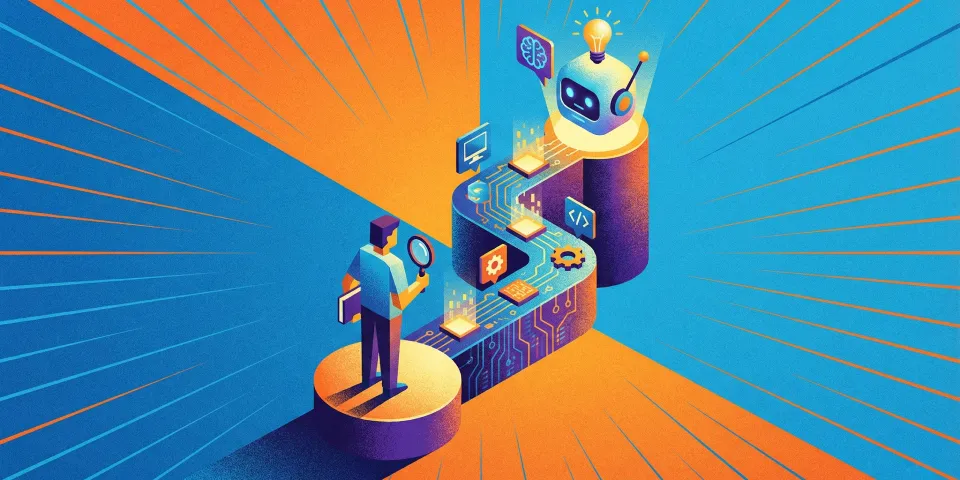
Artificial Intelligence (AI) is no longer just a tech “trend”; it has become the main engine of the Fourth Industrial Revolution. Whether you are a student, an employee looking to change your career path, or an entrepreneur aiming to build intelligent products, learning AI is a strategic investment in your future. This field is broad and multifaceted, so having a clear roadmap is the key to success and avoiding distraction.
Step One: Building a Strong Foundation
You can’t build a skyscraper without solid foundations. In AI, your foundations are mathematics and programming.
1. Mastering a Programming Language (Python)
Python is currently considered the primary language for AI due to its simplicity and the vast ecosystem of libraries that support it.
What to learn:
- Variables
- Functions
- File handling
- Object-Oriented Programming (OOP)
Essential libraries:
- Pandas: for data handling and analysis
- NumPy: for numerical computations and arrays
- Matplotlib & Seaborn: for data visualization
2. Mathematics
You don’t need to be a math professor, but you do need to understand the principles behind the algorithms.
- Linear Algebra: working with vectors and matrices, which are how data is represented in AI
- Statistics & Probability: understanding data, distributions, and predictions
- Calculus: understanding how models are optimized and how error is minimized (optimization)
Step Two: Understanding Machine Learning
This is where the real magic begins. Machine learning is the beating heart of AI.
Core concepts:
- Supervised Learning: such as classification and regression
- Unsupervised Learning: such as clustering
Algorithms:
- Linear Regression
- Decision Trees
- Random Forests
Practical application: Use the Scikit-Learn library to apply these algorithms to simple real-world datasets (such as predicting house prices).
Step Three: Deep Learning and Neural Networks
After mastering the basics, move to the advanced level that mimics how the human brain works.
- Neural Networks: understanding layers, weights, and activation functions
Frameworks:
- PyTorch: preferred for research and flexibility, used by major companies like Meta
- TensorFlow / Keras: supported by Google and widely used in production
Specializations:
- Computer Vision: working with images and video
- Natural Language Processing (NLP): working with text and speech (the foundation of technologies like ChatGPT)
Step Four: Practical Application and Projects
The best way to learn is by building projects.
Theory without practice is blind.
- Kaggle: download ready-made datasets and build models to predict outcomes
- Rebuild projects: replicate existing projects (e.g., a movie recommendation system) and add your own improvements
Step Five: Keeping Up with the Field
The field is evolving at an astonishing pace. The global trend now is toward generative AI.
- Learn how to work with Large Language Models (LLMs)
- Understand Fine-Tuning and Prompt Engineering
- Explore tools like Hugging Face, which offers thousands of ready-to-use models
Recommended Resources to Get Started
Roadmap
- AI Specialization Roadmap (Arabic version) by Mohamed Eltayeb, Click here to view the roadmap
Courses
- Machine Learning Specialization by Andrew Ng (Coursera)
- Practical Deep Learning for Coders by fast.ai
YouTube Channels
- StatQuest with Josh Starmer: simplified explanations of mathematical concepts
- Andrej Karpathy: in-depth explanations of neural networks
Conclusion
The journey of learning AI is a marathon, not a sprint. You may feel frustrated at times due to the abundance of terminology and mathematics, but remember that every expert was once a beginner. Start small, focus on consistency, and apply what you learn step by step. The future is being built now and you have the tools to build it.